US equities trade in four windows on a weekday. Pre-market runs from 4:00 to 9:30 a.m. ET, the regular session from 9:30 a.m. to 4:00 p.m., and after-hours from 4:00 to 8:00 p.m. Overnight trading, from roughly 8:00 or 9:00 p.m. to 4:00 a.m., has existed for several years as well, but only on alternative trading systems, and its trades have reached the consolidated record hours late, once FINRA’s reporting facilities reopen in the morning.
December 6, 2026 is the target date for moving that last window onto the exchanges. The SEC approved Nasdaq’s Night Session in April 2026 on condition that the securities information processors can carry overnight data first, and the SIPs plan to extend their hours that day. Nasdaq overnight trading is scheduled to run from 9:00 p.m. to 3:55 a.m. on Sunday through Thursday nights, alongside an NYSE Arca overnight session. What gets called 24-hour stock trading is really a 23-hour day, five days a week, and once it starts, overnight trades reach the consolidated feed in real time, the same feed most historical datasets, algoseek’s included, are built from.
Broker guides already explain how extended hours trading works for someone placing an order. This piece is for the people who store and model the data, where session boundaries cause quieter problems. In our October 2026 sample, simply counting the 16:00 to 16:04 ET bars as after-hours lifts the mega caps’ after-hours share of volume from 3.6% to 21%. The sections below cover the venues, what changes in the data, and what a month of algoseek data shows.
The session map, before and after December 6
This is as close as US equities have come to 24-hour trading. From December 6 the weekly trading window is due to run from 9:00 p.m. ET on Sunday to 8:00 p.m. ET on Friday, broken only by a one-hour pause each evening from 8:00 to 9:00 p.m. that the exchanges use for clearing, maintenance and the roll to the next trade date (Jones Day; Nasdaq).
| Window (ET) | Before Dec 6 | From Dec 6 | Nasdaq name | NYSE Arca name |
|---|---|---|---|---|
| 4:00 a.m. to 9:30 a.m. | Exchanges, ATSs | Unchanged | Day Session | Early Session |
| 9:30 a.m. to 4:00 p.m. | Exchanges, ATSs | Unchanged, crosses still set official prices | Day Session | Core Session |
| 4:00 p.m. to 8:00 p.m. | Exchanges, ATSs | Unchanged | Day Session | Late Session |
| 8:00 p.m. to 9:00 p.m. | Overnight ATSs only | Exchange pause; ATSs may stay open | Pause | Pause |
| 9:00 p.m. to 4:00 a.m. | Overnight ATSs only | Exchanges join, reported in real time | Night Session (ends 3:55 a.m.) | Overnight Session |
The naming difference matters more than it looks. Nasdaq folds pre-market, regular and post-market into one Day Session while NYSE Arca keeps four, so a filter written against one exchange’s labels will not map onto the other’s. Classifying by timestamp, with exchange session codes kept as metadata, is safer.
Official prices still come from the regular session’s opening and closing crosses, and night orders face tighter rules, including static 20% price bands and no carry-over between sessions.
Who trades the night, and where it shows up
Until December 6, overnight US equity trading happens on three registered ATSs. Blue Ocean ATS launched in 2021 as the first venue built for overnight NMS stock trading and runs from 8:00 p.m. to 4:00 a.m. ET, Sunday through Thursday (Pyth Network). One estimate from FINRA ATS filings gives it 83.7% of overnight notional between February and April 2026, with Bruce Markets at 10.9% and OTC Markets’ Moon ATS at 5.4% (Sapinover).
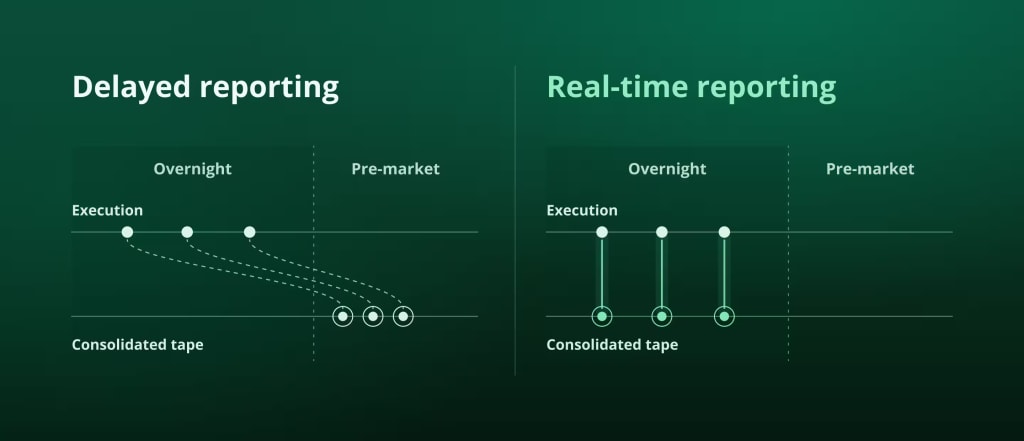
Historical data captures this activity only indirectly. With the SIPs closed overnight, ATS trades executed after 8:00 p.m. have been reported to FINRA once its facilities reopen, at 4:00 a.m. since March 2026 (FINRA), and entered the consolidated data at that point. A SIP-built dataset such as algoseek’s TAQ minute bars, which end at 8:00 p.m. ET, shows no overnight trading as it happened; the night’s trades surface instead among the first pre-market minutes. Real-time overnight prices have reached researchers only through ATS feeds or the vendors that license them.
That same gap held the exchanges back. In August 2026 the SEC declined 24X National Exchange’s request to trade overnight before the SIPs were ready, tying its start to December 6 (WatersTechnology). It also set a fallback start of January 24, 2027 if the SIPs miss that date (SEC). If December 6 holds, the exchange sessions and the consolidated tape arrive together, and a real-time overnight record begins on a single, known day.
What changes in the data
Trade dates stop lining up with calendar dates. Nasdaq assigns trades between 9:00 p.m. and midnight the next calendar day’s trade date, and trades from midnight to 8:00 p.m. the current day’s (Nasdaq). A print at 10:15 p.m. on Sunday belongs to Monday, so a pipeline that partitions files by the calendar date of the timestamp, or assumes a trading day fits between two midnights, will scatter one session across two folders. Keying storage on the exchange trade date, with the raw timestamp kept alongside, avoids that and makes the 8:00 to 9:00 p.m. pause the natural boundary between days.
Overnight trades will also carry the extended-hours sale condition “T” and will not be last-sale eligible (Jones Day). Whether night prints touch a bar’s high, low and last price then comes down to the bar builder’s condition filter. algoseek’s minute bars, for instance, include Form T and extended-hours trades and exclude out-of-sequence, average-price and prior-reference-price prints.
Ask what a “daily” bar means and the answer now depends on who built it. The crosses still set the official open and close, but a 23-hour trade date has its own first print, high and low, and a backtest that mixes official closes with all-session ranges can show moves that never traded.
We ran into a version of this problem before the exchanges’ overnight sessions existed, while building the charts below. The closing cross prints at or just after 4:00 p.m., so a classifier that treats every bar from 16:00 onwards as after-hours sweeps the auction into the evening. In October 2026 algoseek data, Nasdaq-listed names printed their cross inside the 16:00 minute bar, which held between 8% (Tesla) and 23% (Apple) of daily volume for the mega caps. NYSE-listed Alcoa usually printed its close between 16:01 and 16:04, as a handful of exchange trades totalling hundreds of thousands of shares. Counted as after-hours, those minutes made after-hours look like a fifth of mega-cap volume, nearly six times its real size, until we gave 16:00 to 16:04 its own closing window.
Corporate actions bring a boundary of their own. Primary markets will halt affected securities from the start of the overnight session until 8:00 a.m. ET on the effective date of splits, large dividends, ticker changes, spin-offs and similar events (Jones Day), so the first adjusted print may arrive at 8:00 a.m. rather than 4:00 a.m.
December 6 is also a structural break in its own right. Before that date, overnight trades enter consolidated history as a burst of late reports after 4:00 a.m.; after it, they arrive in real time, at the minute they trade. Overnight volume will appear to move out of the first pre-market bars and into the night, so any study that spans the date, from volume profiles to close-to-open returns, has to treat the two periods separately or rebuild the earlier one from ATS data or execution timestamps.
What the data shows
Outside continuous regular trading, the closing window moves more stock than pre-market and after-hours combined for every group of single stocks we measured. We split a month of algoseek minute bars for 16 symbols in four liquidity tiers into pre-market, continuous regular trading, the closing window and after-hours.
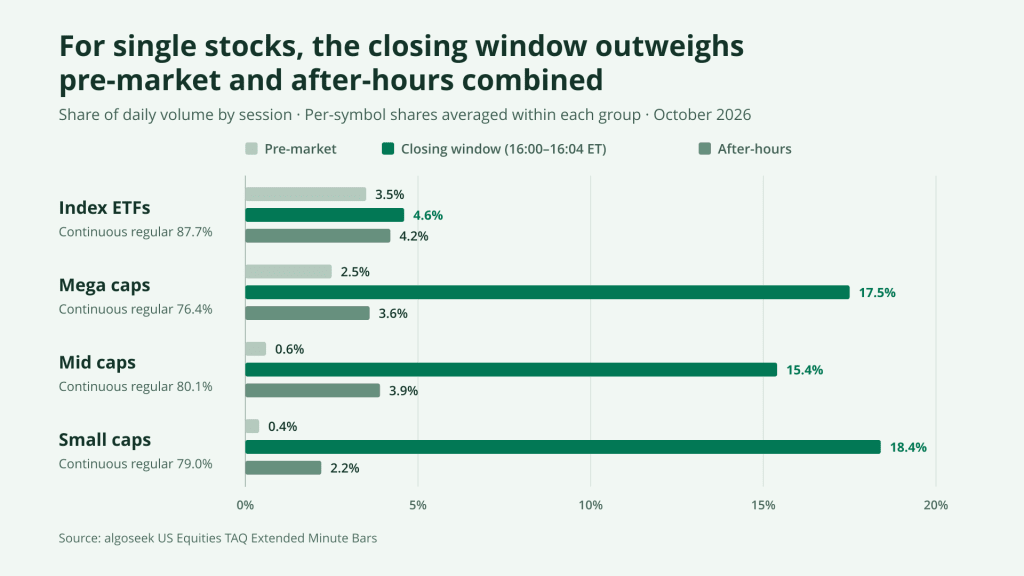
Pre-market and after-hours together carried 6 to 8% of volume for the ETFs and mega caps and under 5% for mid and small caps, and the pre-market figures also absorb overnight ATS trades reported after 4:00 a.m. Index ETFs are the exception to the closing-window pattern: theirs is under 5% of volume, about the same as their after-hours share. Evening volume in smaller names is mostly off-exchange, with off-exchange reported volume making up 93 to 95% of after-hours volume for mid and small caps against 38% for the ETFs. Some of it may be trades arranged earlier and reported late, though confirming that would need execution and report timestamps.
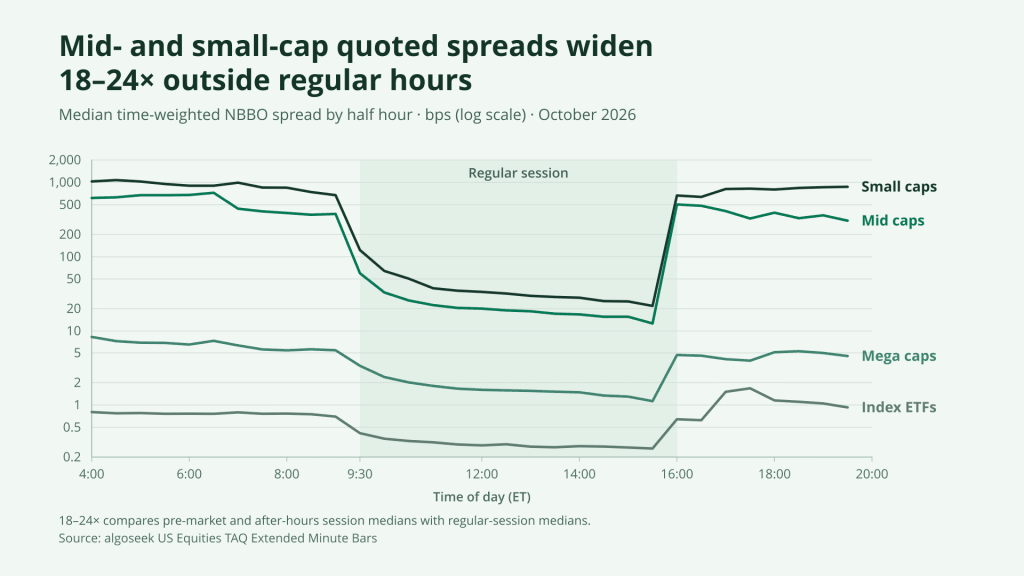
Cost depends far more on the name than on the hour. For index ETFs the median quoted spread moves from 0.30 bps during the day to 0.76 bps pre-market and 1.08 bps after-hours, and the mega caps go from 1.7 bps to 6.4 and 4.7 bps. Mid and small caps sit in a different regime: about 23 and 42 bps during the day, then 420 to 840 bps outside it, or 18 to 24 times their regular-session levels, as quotes thin out and most extended-hours minutes see no trade at all.
Time-weighted quotes also overstate the conditions that trades in thin names actually met, because the few trades that happen tend to arrive when the quote is tighter. Measured at trade times, the quoted spread was about 260 to 320 bps for the mid-cap group outside regular hours and 550 to 590 bps for the small caps, well below the time-weighted figures but still 15 to 20 times their daytime levels. For ETFs and mega caps the two measures sit close together. A backtest that fills extended-hours signals at the midpoint, or applies a regular-hours cost model to them, will overstate returns most for the names where liquidity is thinnest.
Three fields in the bars make this measurable without going back to raw quotes. TimeWeightSpread averages the NBBO spread over the time each quote was in force rather than sampling it at the bar close. SpreadValidTime counts the milliseconds whose quote meets the dataset’s validity rules (both sides present, not crossed or locked, within a band around the midpoint), which keeps implausible quotes out of the average, although a carried-forward quote can still qualify. RelativeSpreadAverage records the quoted spread at the time of each trade.
Getting a pipeline ready before December 6
Most of the work lies in decisions that used to be implicit, and the cheapest time to make them is now, while the night hours are still empty. Session labels belong in one place, defined by timestamp, with the closing window given its own label and each exchange’s session codes kept as a separate field, since Nasdaq’s two sessions and NYSE Arca’s four will never share a vocabulary.
Bar rules deserve the same care. Which condition codes enter OHLC and volume, whether the new overnight prints count toward the high and low, and which close a daily bar reports should be written down and held constant across December 6, so that a change in the numbers reflects the market and not the pipeline. Monitoring needs adjusting as well: a minute-bar day from 4:00 a.m. to 8:00 p.m. has 960 bars, the night session adds up to 420 more, and a job that alerts on unexpected bar counts will fire on the first Monday unless its threshold moves. A note in the study metadata that overnight trades before December 6, 2026 appear as late reports after 4:00 a.m. will save the next reader a wrong conclusion.
For research, the most lasting effect of the overnight session may be the record it leaves behind. Our October numbers show how small extended hours already are for liquid names and how expensive they are for everything else, and there is little reason to expect the night to behave differently. Settling dates, labels and filters before the first print arrives is what lets that record be used from the first week instead of being cleaned up afterwards.
Methodology and sources
The figures come from algoseek’s US Equities Trade and Quote Extended Minute Bars, built from the CTA and UTP SIP feeds including FINRA TRF trades, for the 22 trading days of October 2026. The 16 symbols are index ETFs (SPY, QQQ, IWM), mega caps (AAPL, MSFT, NVDA, AMZN, TSLA), mid caps (AA, FIVE, CROX, LSCC) and small caps (PTON, BJRI, DIN, JACK). Sessions are assigned by bar timestamp in ET, with 16:00 to 16:04 as the closing window. Volume shares are computed per symbol and averaged within each group. Quoted spreads are each bar’s time-weighted NBBO spread over its midpoint, weighted by valid quote time; spreads at trade times use each bar’s average relative NBBO spread across its trades, weighted by trade count. Both are averaged per symbol and session or half hour, then taken as the group median.
The sample is small, and October included earnings for several names. Low-priced stocks inflate spreads in basis points: one cent on Peloton, at $5.18, is about 19 bps. Some off-exchange volume reported just after the close may be trades priced at the close and reported late; we have not checked execution against report timestamps.
Sources: Nasdaq, 23/5 trading · SEC, approval of Nasdaq’s 23/5 rule change (Release 34-105199) · SEC, 24X conditional exemptive order (Release 34-106061) · FINRA, Regulatory Notice 26-07 · Jones Day, NYSE and Nasdaq move to 23-hour trading day · WatersTechnology, SEC denies 24X’s requested SIP exemption · Pyth Network, Blue Ocean ATS joins Pyth · Sapinover, overnight venue patterns · algoseek, TAQ Extended Minute Bar guide